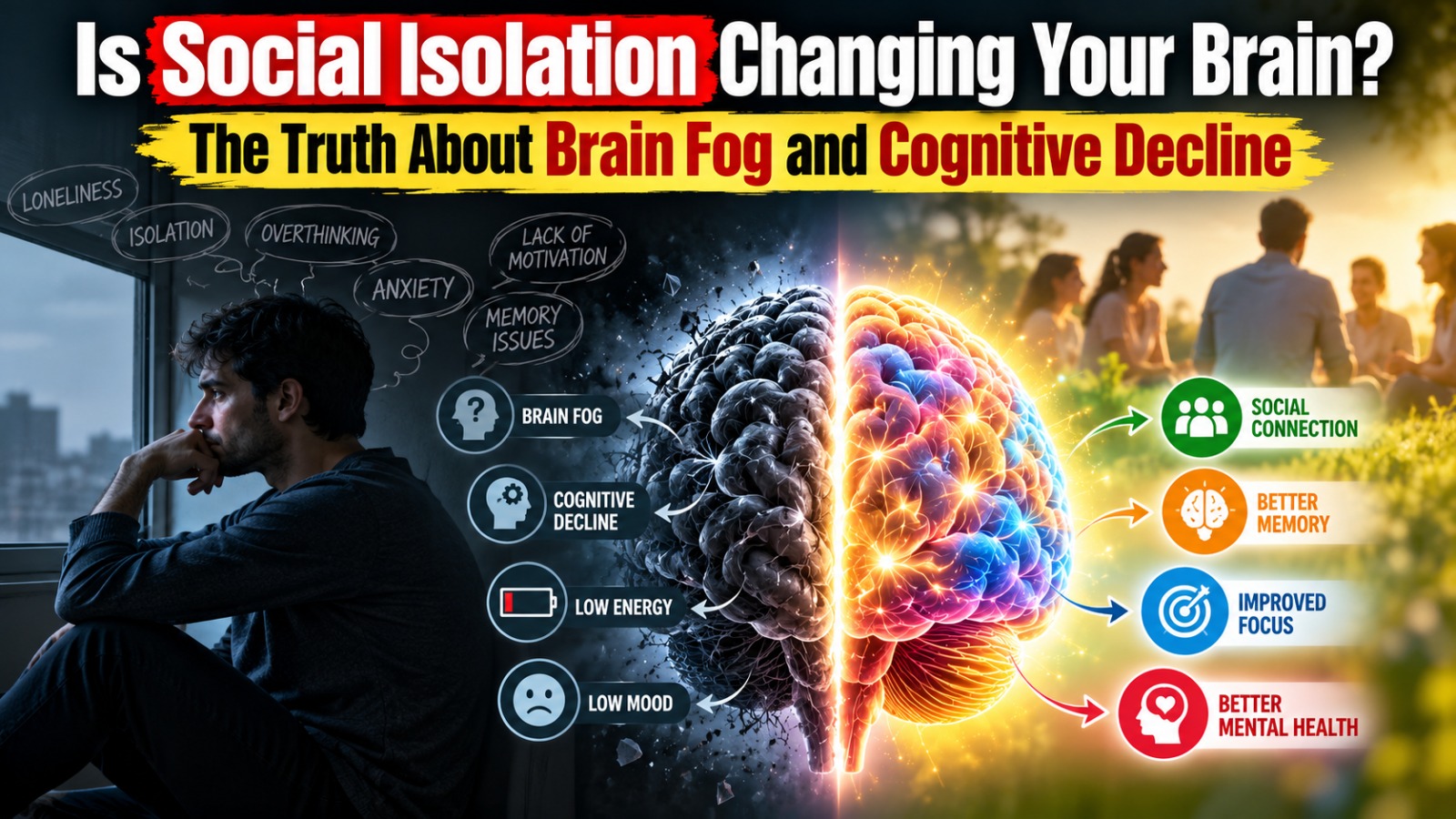
Let’s talk about something subtle but powerful: how social isolation—especially since COVID—may be changing your brain in ways you don’t even realize. You might be feeling it as brain fog. But what’s really going on underneath?
Brain Fog: More Than Just Feeling Tired
Brain fog isn’t a diagnosis in itself, but you’ll know it when it happens:
- You feel like you’re thinking in slow motion
- You struggle to find the right words
- Your brain feels heavy, tired, or fuzzy—even if your body isn’t
Sound familiar?
Why Would Isolation Cause Brain Fog?
Turns out, our brains are wired for social interaction. And when we don’t get enough of it, especially over time, the brain starts to change structurally.
Before COVID, we mostly saw this in older adults living alone, often with limited mobility or access to family. Research showed that isolation in these cases hastened cognitive decline and even increased the risk of Alzheimer’s disease.
But since the pandemic, we’ve seen similar changes in younger people too.
What’s Really Happening in the Brain?
Your brain is made up of billions of nerves that connect to one another. The strength of these connections is what determines how fast and efficiently your brain works.
When you’re isolated:
- Those nerve connections weaken.
- Inflammation increases.
- Critical regions of the brain—like the hippocampus, temporal, and frontal lobes—begin to shrink.
That’s not just theory. In a study involving over 32,000 participants, researchers used brain scans to show actual brain volume loss in socially isolated individuals.
Isolation Hurts Your Social Cognition
Social cognition is your brain’s ability to:
- Read facial expressions
- Recognize familiar faces
- Interpret tone of voice
- Understand others’ thoughts, feelings, and intentions (known as theory of mind)
These are learned skills, and while you pick them up early in life, they require constant practice to maintain. Without regular social interaction, these abilities can fade—not just emotionally, but neurologically.
The Silver Lining: Your Brain Can Rewire Itself
Here’s the good news: your brain is resilient.
Even if you’ve lost connections due to isolation, depression, or illness, your brain has the ability to regrow and strengthen them. This process is called neuroplasticity.
Build Your Brain’s Backup System: Cognitive Reserve
Think of cognitive reserve as your brain’s mental buffer. It’s what helps you keep functioning even when your brain has taken a hit—whether from stress, aging, or damage.
It’s like a backup generator that kicks in when the power goes out.
Some people can reach their 80s with sharp memory and focus. Others start struggling in their 60s. A big reason for this difference is how much cognitive reserve they’ve built up over the years.
How to Increase Your Cognitive Reserve
Here are five powerful ways to build a more resilient brain:
1. Education
It’s not about where you went to school—it’s about staying curious. Keep learning, even informally, throughout your life.
2. Social Interaction
Regular conversations, even casual ones, keep your brain in practice. Stay connected.
3. Mentally-Challenging Work
Work that stretches your thinking—problem-solving, strategizing, learning new skills—is brain-strengthening.
⚠️ Note: A stressful job with unrealistic deadlines is not the same as a mentally-stimulating job. Mental challenge should feel engaging, not just overwhelming.
4. Brain Games and New Skills
Activities like crossword puzzles, reading, learning a new language, or picking up an instrument keep your neurons firing.
5. Physical Exercise
Exercise doesn’t just benefit the body—it boosts nerve growth and brain plasticity. I go deeper into this in my video on how exercise rewires the brain.
What If Your Job Drains You?
Not everyone has a stimulating job. That’s okay. You can compensate:
- Do puzzles on your lunch break
- Go for a brisk walk before work
- Learn something new in the evening
- Listen to informative podcasts on your commute
The key is intentional brain engagement.
The Tools Are in Your Hands
We can’t always control our circumstances—but we can control how we support our brain.
Yes, diet, sleep, and self-care matter too. But what I love about this list is that it’s filled with things within your control—regardless of your background or resources.
Even free YouTube videos and online courses can give you a world-class mental workout. You just have to stay curious.
Final Thought
If you’re feeling forgetful, foggy, or disconnected, know this:
Your brain may be struggling with the effects of isolation or stress.
But it’s not permanent, and it’s not too late.
With consistent effort, you can rebuild, rewire, and reclaim your mental clarity.